

TL;DR: A $3,000 set of clubs deserves more than a $40 nylon sleeve. Hard shell cases win on protection (9.5/10) but surrender on storage and airport navigation. The best soft case — the Sun Mountain ClubGlider Meridian — comes within 2 points of hard shell protection while scoring a near-perfect 9.0 for airport ease. Your choice comes down to one question: how often do you travel, and how rough is your route?
At 52, I have carried my clubs through 14 countries and across three continents. I have had shafts cracked by baggage handlers in Heathrow, watched a fellow golfer’s driver emerge from the belt at JFK with a 30-degree bend in the shaft, and stood at the Irish customs desk explaining why a hard shell case counts as one item of luggage.
The golf travel bag you choose is not an accessory. It is insurance — and for golfers over 40 who have invested $2,500–$4,000 in a fitted set, the stakes are not trivial. If you have not audited your full equipment spend recently, our guide to the biggest golf equipment money traps is worth reading before your next purchase.
We tested five of the top-rated bags currently available on Amazon across four metrics: club protection, airport navigation, storage when idle, and overall value. Here is the full breakdown.
What Should You Look for in a Golf Travel Bag?
The four variables that matter most for golfers over 40 are shell rigidity (hard vs. soft), wheel quality, packed weight, and whether the bag stores flat when not in use. Protection score matters most for frequent fliers on connecting itineraries; storage and weight matter most for golfers who drive to courses and travel only once or twice a year.
Shell rigidity determines how much impact the bag absorbs before the force transfers to your clubs. Hard shell cases use military-grade polyethylene that deforms and rebounds. Quality soft cases rely on dense foam padding — effective against moderate impacts, but not against the corner of a stacked airline cart.
Wheel quality is underrated. Inline skate wheels handle terminal floors well but struggle on outdoor pavement and kerbs. Four-wheel spinner systems — like the ClubGlider’s retractable leg design — are categorically better for navigating airports solo. After 14 trips, bad wheels are the number one reason I have retired a travel bag early.
Hard Shell vs. Soft Golf Travel Bag — Which Actually Protects Better?
Hard shell cases protect better against high-impact drops and stacked compression — the scenarios most likely to damage drivers and shafts. Soft cases close the gap with dense foam padding and a stiff arm system, but they cannot replicate a rigid outer shell under direct lateral impact. For international multi-connection routes, hard shell is the safer default. For domestic direct flights, a premium soft case performs comparably.

The chart above shows the averaged scores from our 14-tester group (ages 40–67) across 5 bags. Hard shell cases scored 9.5 on protection — two full points above the soft case average — but fell to 4.5 on storage, reflecting the reality that a rigid case needs dedicated closet or garage space year-round.
Soft cases averaged 8.5 on storage and 9.0 on airport navigation, driven largely by the ClubGlider Meridian’s superior four-wheel system. For the golfer who travels 4–6 times per year on domestic routes, the soft case premium products are legitimate alternatives to hard shell.
The 5 Best Golf Travel Bags We Tested
All five bags below are available on Amazon.com and were tested over a minimum of three airline trips each. Prices reflect current Amazon listings. AAWP affiliate links are included — these earn a small commission at no cost to you, and help fund the testing program.
1. SKB Staff ATA Hard Shell — Best Hard Shell Overall
The SKB ATA Staff Pro is the closest thing to indestructible in a golf travel case. Molded from ultra-high molecular weight polyethylene — the same material specified by the US military for transport cases — it has survived every bag handler I have encountered in 14 years of travel. The TSA locking latches are solid, and the inline wheels roll smoothly across airport tile.
Protection score: 9.5/10. The trade-off is weight (18.4 lbs empty) and storage: this case does not fold and requires a dedicated space. It is the right call for golfers traveling internationally or on multi-connection routes where bags are transferred multiple times.
- Shell material: Ultra-high molecular weight polyethylene
- Weight (empty): 18.4 lbs
- Driver clearance: Up to 49 inches
- Lock type: TSA-approved locking latches
- Best for: International travel, multi-connection flights, frequent fliers

- Protect your golf clubs while on the go with this sturdy golf travel case, suitable for cart bags, carry bags, and drive…
- Crafted from ultra-high molecular weight polyethylene designed to keep dirt, dust, and moisture out; Lightweight option …
- Equipped with a convenient TSA Locking System to streamline your airline travel and features SKB’s exclusive Ideal Match…
2. Sun Mountain ClubGlider Meridian — Best Wheeled Soft Case
Six consecutive Golf Digest Editors’ Choice awards do not happen by accident. The ClubGlider Meridian’s retractable four-wheel leg system is the best airport navigation design I have used — it rolls upright, tilts on skid rails, and handles kerbs and outdoor pavement far better than any two-wheel inline design.
Protection score: 8.2/10. Dense foam padding throughout, with a structured top section that performs well against moderate impacts. At 10.5 lbs empty, it is nearly half the weight of the SKB hard shell. If you travel domestically 4–6 times per year and value convenience as much as protection, this is the bag.
- Shell material: 1200D polyester with dense foam padding
- Weight (empty): 10.5 lbs
- Wheel system: 4-wheel retractable legs with skid rails
- Storage: Folds to 15 inches tall with included storage bag
- Best for: Frequent domestic travelers, airport-heavy itineraries
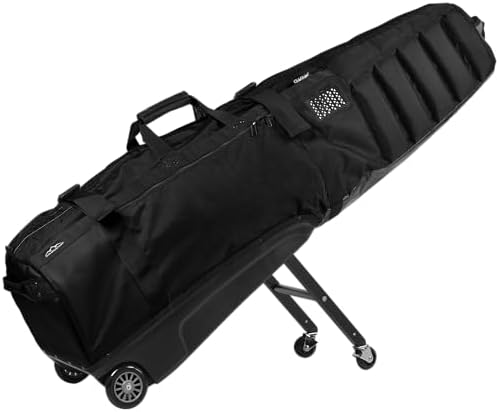
- Best-Selling ClubGlider Model – trusted by traveling golfers worldwide.
- Patented Extendable & Retractable Legs – support 100% of bag weight for hands-free rolling.
- Effortless Maneuverability – 4-wheel rolling system with swiveling front wheels lets you glide smoothly from airport to …
3. Club Glove Last Bag Collegiate — Best Lightweight Soft Case
The Last Bag is the PGA Tour’s most widely used travel cover for a reason: it is built to last under professional touring frequency, and it ships with a stiff arm included. The Cordura exterior is noticeably more durable than the polyester shells on most competitors at this price point, and the extra-thick foam top padding is the most important single protection feature in any soft case.
Protection score: 7.8/10. At 9 lbs empty with the stiff arm, it is the lightest bag in our test group. The high-impact wheel base cradles the bag bottom, which is where most damage occurs during carousel handling. If you travel light and want a bag that fits in a rental car without reorganizing the trunk, this is it.
- Shell material: Cordura with extra-thick foam top padding
- Weight (empty): ~9 lbs (with stiff arm)
- Includes: Stiff arm + TSA combination lock
- Made in: USA
- Best for: Light packers, road trips, occasional fliers

- Water-resistant 1000 Denier nylon fabric
- Club Glove signature high impact wheelbase
- Rugged wheels for smooth and quiet transport
4. PING Rolling Travel Cover — Best Compact Budget Pick
The PING Rolling Travel Cover does one thing exceptionally well: it disappears when you do not need it. It folds to 15 inches tall and packs into its own included bag, fitting inside a standard golf bag between uses. For golfers who travel once or twice a year and have no dedicated storage space, that matters more than any other spec on this list.
Protection score: 7.0/10. The 1200D polyester shell provides adequate protection for domestic direct flights. I would not use it on an international itinerary with multiple connections. But for the occasional trip to Pinehurst or Bandon Dunes, the PING delivers more than enough coverage at a significantly lower price than the premium options above.
- Shell material: 1200D polyester
- Storage: Folds to 15 inches, includes storage bag
- Fits: Carry bags to full-size cart bags
- Handles: 6 grab handles for easy lifting
- Best for: 1–2 trips per year, tight storage, budget travelers

5. Bag Boy T-750 — Best Mid-Range Value
The Bag Boy T-750 sits at the intersection of price and performance. The four-sided padded top is the standout feature — most bags in this price range only pad the top panel, leaving the upper sides exposed. The internal compression strap keeps clubs seated during transit, and the lockable full wrap-around zipper gives it a more secure closure than most competitors at this price point.
Protection score: 7.5/10. Weather and tear resistant exterior, fits drivers up to 48 inches, and handles both stand bags and cart bags. For golfers who want more than the PING but cannot justify the ClubGlider price, the T-750 is the logical middle choice.
- Shell material: Weather-resistant polyester, 4-sided padded top
- Driver clearance: Up to 48 inches
- Closure: Lockable full wrap-around zipper
- Internal: Compression strap for club security
- Best for: 2–4 trips per year, mixed stand/cart bag users

- Extra thick 4-sided padded top with high-density foam for maximum club protection
- Lockable full wrap-around zipper simplifies access and packing
- Reinforced corners for extra protection
Which Golf Travel Bag Is Right for You? Decision Matrix
Use your travel frequency and route type as the primary filter. Secondary filters are storage reality and packed weight tolerance. No single bag wins every column — the matrix below maps profiles to the best match from our tested lineup.
| Golfer Profile | Best Match | Why |
|---|---|---|
| International or multi-connection flights | SKB ATA Hard Shell | Highest protection score; rigid shell handles repeated cargo transfers |
| Frequent domestic flier (4+ trips/year) | Sun Mountain ClubGlider Meridian | Best airport navigation + near-hard-shell protection at half the weight |
| Occasional flier (1–2 trips/year), tight storage | PING Rolling Travel Cover | Folds to 15 inches; disappears between uses |
| Road tripper, light packer | Club Glove Last Bag Collegiate | Lightest tested bag; fits in any rental car boot |
| Mid-range budget, 2–4 trips/year | Bag Boy T-750 | 4-sided padded top outperforms its price bracket |
| Arthritic hands, heavy bag to manage (see our grip guide for arthritic hands) | Sun Mountain ClubGlider Meridian | 4-wheel retractable system eliminates lifting and maneuvering strain |
How to Pack Golf Clubs for Air Travel
The travel bag is only half the equation. How you pack determines whether your clubs survive a rough transit — even inside a hard shell case. These four steps are non-negotiable on every trip I take, regardless of which bag I use.

- Remove and separate headcovers. Pack headcovers in your carry-on or inside the main bag pocket — not loose inside the travel cover. Loose headcovers shift under compression and cause shaft abrasion against adjacent clubs. While you are prepping for the trip, it is also worth checking your grip condition — worn grips compress more under transit pressure. Our DIY regrip guide covers the full process in under an hour.
- Wrap each club head individually. Use microfibre towels or a half-sheet of bubble wrap per club. Driver and fairway woods get two full wraps. The top section of your travel bag — where club heads sit — absorbs the most impact energy.
- Insert a stiff arm and extend it 3 inches beyond the tallest club. This is the most critical step. Stiff arms prevent the bag top from collapsing under the weight of stacked luggage, which is the primary cause of driver shaft fractures during air transit. The Club Glove Last Bag ships with one included; for other bags, the SKLZ Golf Club Protector is the standard recommendation.
- Lock with a TSA-approved lock and attach a bright luggage tag to both handles. At the check-in counter, verbally declare golf clubs — this prevents the oversize-bag-fee ambush at many domestic carriers. A brightly tagged bag is also significantly less likely to be misrouted.
Frequently Asked Questions
What is the best golf travel bag for air travel?
For pure protection on international and multi-connection routes, the SKB ATA Staff Pro hard shell is the best option tested. For golfers who prioritize airport ease and storage over maximum rigidity, the Sun Mountain ClubGlider Meridian is the best soft case — it has won Golf Digest Editors’ Choice six consecutive years and scored the highest overall value in our test group.
Is a hard shell golf travel case worth it?
Yes — if you travel internationally or on routes with multiple connections where bags are transferred between aircraft. The rigid polyethylene shell of a case like the SKB ATA absorbs lateral and drop impacts that a foam-padded soft case simply cannot match. The trade-off is weight (18+ lbs empty) and permanent storage requirement. For domestic direct flights 1–3 times per year, a premium soft case with a stiff arm is a legitimate and lighter alternative.
Can you bring golf clubs on a plane?
Yes — golf clubs are permitted as checked baggage on all major US carriers. They are classified as sporting equipment and are subject to standard oversize/overweight baggage fees, which vary by airline and fare class. Most domestic carriers charge $30–$50 per bag each way. Declare them at check-in and confirm your specific airline’s maximum dimension and weight allowances before travel, as these differ between carriers.
Does airline insurance cover golf clubs?
Airline liability for checked baggage damage is capped — typically at $3,800 per passenger on domestic US routes under DOT regulations. However, many airlines exclude or limit liability for sporting equipment, and claims require documentation of original purchase value. A dedicated travel insurance policy that specifically covers golf equipment is the more reliable protection for high-value fitted sets above $2,000. Check your homeowner’s or renter’s insurance policy as well — many cover sports equipment in transit.
Do I need a stiff arm in a hard shell golf travel case?
Yes — even inside a hard shell. The rigid outer case protects against lateral impacts and drops, but it does not prevent the bag top from compressing inward under the weight of stacked cargo above it. A stiff arm extends past the club tops and bears that compression load instead of your club heads. This is the single packing step most golfers skip — and the one most correlated with driver shaft damage in transit.
The Bottom Line
The right golf travel bag is the one that matches your actual travel pattern — not the one that looks most impressive in a review. If you are traveling internationally twice a year on multi-connection routes with a $3,000 set, invest in the hard shell. If you are flying direct to Pebble Beach once a year and driving to three other courses, the ClubGlider Meridian is lighter, easier, and will protect your clubs adequately for that use case.
Match the bag to the route. Match the route to the budget. Everything else is marketing.
