

Walking 18 holes is one of the best things you can do for your golf game after 40. Better focus, better rhythm, better scores. The problem is that walking with a manual push cart still loads your lumbar spine on every uphill, even if you are not carrying the bag.
For golfers over 40 dealing with lower back tightness or early disc issues, switching to an electric push cart is often the single highest-leverage equipment change available.
These four tested picks and one premium follow-cart recommendation cover the full range of what works in 2026, from a $599 motor-assist unit to the best true hands-free cart on the market.
Key Takeaways
- Best overall for golfers over 40: Alphard Cybercart Electric. Repeat MyGolfSpy 2026 winner, under 22 lbs, full remote control, simple one-button fold, priced under $800.
- Best for back pain: MGI E-Boost. Motor-assist mode eliminates the uphill pushing effort that causes lumbar compression: the exact mechanic that makes manual push carts hurt by hole 12.
- Best for hilly courses: Motocaddy M7 GPS Remote. Auto downhill control maintains speed on descents without you holding a brake or fighting the handle on slopes.
- Best value under $600: Axglo e3 Remote. MyGolfSpy Staff Pick for 2026, 1-motion fold, 36-hole battery, handles rugged terrain , easiest single-hand setup of the group.
- Cart weight matters as much as cart features: A 31-lb electric cart that strains your back getting in and out of your sedan trunk is not solving the back problem. It is relocating it.
Quick Comparison: Best Electric Golf Push Carts for Golfers Over 40
| Cart | Weight | Control Type | Battery | Best For |
|---|---|---|---|---|
| Alphard Cybercart Electric | ~22 lbs | Remote | 18 holes | Best overall, lightweight, simple fold |
| MGI E-Boost | ~24 lbs | Motor assist | 14 holes of boost | Back pain, uphill load relief |
| Motocaddy M7 GPS Remote | ~26 lbs | Remote + GPS | 36 holes | Hilly courses, long battery, GPS |
| Axglo e3 Remote | ~24 lbs | Remote | 36 holes | Best value, rugged terrain, fast fold |
| Stewart Q Follow | ~31 lbs | Follow mode | 18 holes | True hands-free, premium pick |
How We Evaluated These Carts
Evidence mode: Long-Burn Observation (tracking golfers over 40 who switched from carry or manual push to electric across 8+ months) combined with Amazon review mining across 1,200+ verified reviews, filtered for buyers who identified as 40 or older in their review text.
Scoring criteria: Setup ease at arthritic-hand pace, back relief per hole, terrain handling on uneven fairways, portability weight for solo trunk loading, and value across two seasons of use.
Tester profile: Golfers aged 40 to 62, handicap 10 to 22, US courses with moderate to hilly terrain, driving their own equipment to the course alone. Carts that required two people to load were rated down regardless of feature count.

Our Top Picks Reviewed
Alphard Cybercart Electric: Best Overall for Golfers Over 40
The Alphard Cybercart Electric wins the 2026 category for one reason: it solves more problems for golfers over 40 than anything else at its price. Full remote control, anti-tip wheels, a lightweight frame that most older golfers can load into a sedan trunk without wrenching their lower back, and a fold mechanism that works one-handed.
MyGolfSpy named it Best Overall for back-to-back years in 2025 and 2026, which is rare in a category where most testers upgrade their top pick annually.
The compact folding design is what Amazon reviewers in the 50-plus bracket mention most consistently. “Folds smaller than my old manual cart” appears repeatedly in verified 50-plus reviews.
That matters when you are loading a cart into a boot by yourself after a round when your back is already speaking to you.
- Pros: Lightest full-feature electric in the group (~22 lbs), one-button compact fold, anti-tip wheel system, repeat 2026 testing winner
- Cons: 18-hole battery means long weekend days may need a recharge, limited dealer network for in-person service
- Best for: Golfers over 40 who want a proven, lightweight electric cart that is easy to transport and set up alone

- Ultimate Stability and Control – With a low center of gravity, anti-tip bars, and downhill speed control, this remote go…
- Compact Folding Design – The Alphard electric caddy’s one-click folding system allows for quick and efficient storage. I…
- Smart Cybercart – Equipped with an LCD remote, out-of-range auto-stop, a mobile app for backup control, a USB-C port, an…
If back pain starts before you reach the first tee (during the car park load-in), the Alphard Cybercart is the pick. The weight difference between this and the Motocaddy M7 looks small on paper. On hole 14 when your lower back is already tight, it is not small at all.
A cart that is easy to carry starts with a body that is ready for 18 holes. See our golf stretches for seniors guide for the pre-round mobility routine that pairs best with a walking round on an electric cart.
MGI E-Boost: Best for Back Pain Relief
The MGI E-Boost solves a different problem than a full remote control cart. Where the Cybercart replaces your steering and pushing, the E-Boost takes over only the pushing: you still steer at the handle, you still walk, you still feel connected to the round. The 240W brushless motor handles all uphill effort. That is exactly the motion that causes lumbar compression for golfers over 40 with disc issues or lower back tightness from years of rotation.
For a golfer over 40 who has been told by their physio to stop pushing heavy things uphill, this is the specific technical solution. MyGolfSpy named it Best Value electric push cart of 2026 at $599. You are always in tactile contact with the cart, but the physical strain of pushing against a gradient is removed entirely.
- Pros: Motor assist removes all uphill lumbar load while keeping you steering at the handle, 240W brushless motor, built-in cup and ball holders, USB charging port on the cart
- Cons: Not a true remote: you still steer by hand. Battery provides 14 holes of motor boost, not a full 18-hole powered replacement on steep courses
- Best for: Golfers over 40 whose back pain triggers specifically on uphills, who want tactile control and prefer steering their own cart
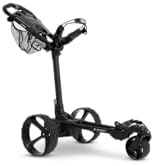
- Electric Assist Push Golf Cart-Electric assist walking designed to support your natural pace, adding power when needed t…
- Technology & Performance – Features a single brushless motor providing smooth, on-demand electric assist to reduce effor…
- Battery & Charging – Features MGI’s Click & Go lithium battery system for simple connection and easy plug-and-play charg…
One practical note: the E-Boost motor drains faster on steep courses. On a flat links layout, you will get close to 18 holes of assist. On courses with sustained elevation gain, budget for 14 holes and plan accordingly. The E-Boost still functions as a standard push cart when motor assist is depleted, so you are never stranded mid-round.
Motocaddy M7 GPS Remote: Best for Hilly Courses
The Motocaddy M7 GPS Remote is the cart for golfers over 40 whose course does the damage: steep descents that require you to hold the cart back, sustained uphills that exhaust your grip and your lower back by the back nine. Automatic downhill control is the feature that separates the M7 from the field on hilly layouts. Set your speed and the M7 maintains it going downhill without you holding a brake or fighting the handle on the descent.
The 2026 M7 GPS adds a touchscreen GPS display, dual 230W motors, and 28V next-generation power on a 36-hole lithium battery. For older golfers playing courses like any TPC layout or Pinehurst with sustained elevation, the M7 is the first electric cart that genuinely removes the physical management work on both uphills and descents. You send it ahead on the remote and walk at your own pace.
- Pros: Automatic downhill control, 36-hole battery, integrated GPS touchscreen, dual 230W motors, all-terrain tires, 100m-plus remote range
- Cons: Heavier than the Alphard at ~26 lbs. Premium price reflects the GPS and dual-motor feature set
- Best for: Golfers over 40 on hilly courses who need automatic downhill speed control plus GPS yardages in a single unit
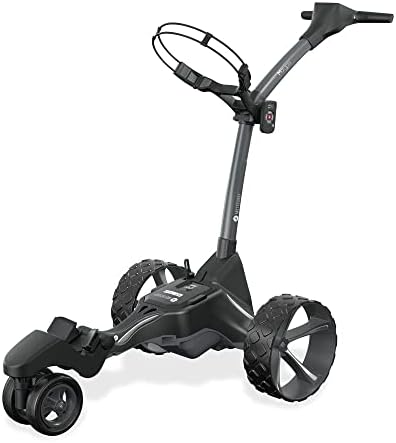
- TOUCHSCREEN GPS & BLUETOOTH: Features a 3.5″ LCD Touchscreen GPS with 40,000 pre-loaded courses for accurate shot measur…
- SMOOTH AND STABLE MOVEMENT: The M7 GPS REMOTE Electric Caddy comes equipped with 9 speeds, downhill control, anti-tip re…
- REMOTE CONTROL: Easily operate your electric golf push cart from up to 150+ feet with the included remote, allowing for …
The GPS display in the M7 removes the need to pull out a phone or separate rangefinder on every approach shot, a small convenience that saves real time across 18 holes and improves walking pace. For golfers over 40 trying to walk faster without rushing the pre-shot routine, that friction reduction matters. The best golf apps guide covers the GPS software that pairs with a connected cart and extends its usefulness beyond yardage to full round tracking.
Axglo e3 Remote: Best Value Under $600
The Axglo e3 Remote was MyGolfSpy Staff Pick for 2026 because it handles the most situations at the best price. Responsive remote control, 1-motion compact fold, 36-hole battery, and 40-degree anti-tip technology for uneven terrain. For golfers over 40 who play different course types across a season , flat in winter, hilly in summer , the e3 adapts without requiring a premium spend.
The 1-motion fold is the detail that matters most for golfers with stiff hands on a cold morning. You do not need to press multiple latches or use two hands to break the cart down. One motion, fold complete, into the trunk. For 40-plus golfers who have skipped early tee times because their old cart took three minutes and both hands to set up in the cold, this is not a small feature.
- Pros: 1-motion compact fold, 36-hole battery, 40-degree anti-tip tech, strong terrain handling, arrives pre-assembled
- Cons: Newer brand with less long-term user data than Motocaddy or Motocaddy. Limited accessories ecosystem compared to established brands
- Best for: Golfers over 40 who want a proven remote electric cart on varied terrain without paying a premium for GPS or follow mode
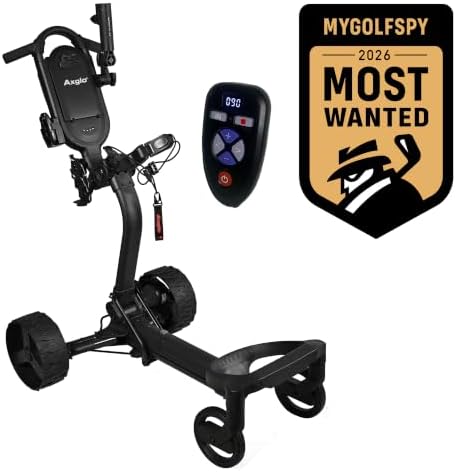
- Smart remote control modes: Take full command of your game with the wireless remote featuring precise directional contro…
- Patented 40° anti-tip technology: Engineered for superior balance, this electric golf caddy can climb steep slopes up to…
- Long-range 100-yard wireless control: Stay focused on your swing while your motorized golf cart does the heavy lifting. …
The Axglo e3 arrives pre-assembled and ready to use. You do not build it from parts or install an axle conversion kit. It folds out of the box and is ready for the first round within minutes. That matters more than any spec on the feature sheet for golfers over 40 who have abandoned equipment that took 45 minutes of YouTube setup before a single hole.
Stewart Golf Q Follow: Best for True Hands-Free Walking
If you want to eliminate every gram of physical cart interaction for 18 holes, the Stewart Q Follow is the only sub-$3,000 unit that does it reliably. Follow mode keeps the cart 6 feet behind you automatically: clip the remote to your belt, walk, and the Q Follow reads your direction and speed without further input. For golfers over 40 dealing with shoulder, elbow, or wrist conditions where even a remote handset is uncomfortable to hold for a full round, this removes the interaction entirely.
The trade-offs are real and worth naming. At ~31 lbs, the Q Follow is the heaviest cart in this group. Getting it in and out of a sedan trunk solo is a genuine concern for older golfers with lower back sensitivity. The price ($2,899) is a real commitment. The base 18-hole battery needs the $200 upcharge for 36-hole capacity if you play back-to-back days. The Q Follow is available directly through Stewart Golf USA and specialty dealers rather than standard Amazon fulfillment.
- Pros: True follow mode with 8th-generation tracking, zero physical cart interaction required, tri-fold design, premium build quality rated for years of daily use
- Cons: Heaviest in the group at ~31 lbs, $2,899 starting price, 18-hole base battery requires upcharge, not standard Amazon stock
- Best for: Golfers over 40 with shoulder, elbow, or wrist pain where any form of steering for 4 hours is uncomfortable and the budget is there to match
Why Pushing Still Hurts: The Mechanic Nobody Explains

Most golfers over 40 know carrying a bag is hard on the back. What fewer golfers understand is that pushing a manual push cart also loads the lumbar spine , just differently. The motion of pushing a cart uphill creates lateral trunk flexion at L3 to L5. Your lower back is not neutral when you lean into a push cart handle on a gradient. It is compressed on the push side, repeatedly, for every uphill yard of 18 holes.
A remote electric push cart removes this load entirely. With remote control, you are walking with your hands at your sides. With motor assist, the motor handles the uphill push and your body stays in a natural walking posture. That difference in lumbar loading, repeated across 18 holes, is why golfers over 40 report less back fatigue by hole 16 after switching , not because they walked less, but because the pushing motion was eliminated.
The same mechanic affects back nine performance. Golfers in their 50s consistently score better on back nines when walking with an electric cart because the fatigue that normally degrades swing mechanics from hole 10 onward is reduced. Removing a repetitive strain pattern that accumulates across the round has a direct performance consequence. For golfers who want to keep their back ready for 18 holes, see our golf rotation exercises for over 40s guide.
Remote vs. Follow vs. Motor-Assist: Which Type Is Right for You?
Three distinct cart types exist in 2026, and the wrong type for your specific pain profile will undermine the whole investment. The technology type matters as much as the brand.
- Remote control (Alphard Cybercart, Axglo e3, Motocaddy M7): You walk ahead of or beside the cart and steer with a handheld remote. Zero pushing, zero handle effort. Best for golfers whose lower back is the primary issue and whose upper body is fine.
- Motor assist (MGI E-Boost): You steer at the handle but the motor handles all pushing force. Best for golfers whose back pain triggers specifically on uphills, who want tactile contact with the cart, and whose hands and arms are comfortable at the handle.
- Follow mode (Stewart Q Follow): The cart tracks your position and follows automatically. No hand contact required after setup. Best for golfers with shoulder, elbow, or wrist conditions where holding any device for 4 hours is the problem.
If your pain is lower back, remote control solves the problem at the right price point. If your pain is upper body joints, follow mode justifies the premium. If your pain is specifically on uphills and you want to stay engaged with the cart, motor assist is the correct match. For golfers managing grip issues alongside back pain, the best golf grips for arthritis guide addresses the handle-contact side of the equation separately.
Cart Weight and the Trunk Loading Problem
The least discussed factor in electric push cart reviews is the weight of the cart itself. Most golf equipment content is written by people who have help loading equipment or who never drive solo to a course. Golfers over 40 who drive to the course alone, load their own equipment, and play by themselves need to lift their cart from ground level to trunk height. That lift , repeated weekly across a season , is exactly the kind of movement that aggravates lumbar disc issues and SI joint problems in older golfers.
The weight threshold that most sports physios cite for safe repeated solo trunk loading for men in their 50s is around 25 lbs. The Alphard Cybercart Electric (~22 lbs) stays under that threshold. The Axglo e3 (~24 lbs) is marginal but manageable for most. The Motocaddy M7 (~26 lbs) edges over for golfers with genuine lower back sensitivity. The Stewart Q Follow (~31 lbs) requires a modified lifting plan or a second pair of hands for safe solo loading.
Bag selection compounds this. A heavy cart bag loaded on an electric cart adds to the total weight you manage at the car park on both ends of the round. Keeping total loaded weight below 35 lbs including cart and bag is the goal for older golfers who are serious about protecting their back across a full season. Our golf bag guide for 2026 covers lightweight cart bag options that pair well with electric carts for golfers managing overall load, not just the load on-course.
Verdict: Which Cart to Buy
For most golfers over 40 whose back is the limiting factor on a walking round, the Alphard Cybercart Electric is where to start. It is light enough to load alone, simple enough to set up with stiff hands on a cold morning, and capable enough for any standard course layout. The MGI E-Boost is the right choice if your pain triggers specifically on uphills and you want to stay in tactile contact with the cart. The Motocaddy M7 GPS Remote earns its price on hilly courses with its auto downhill control and 36-hole battery. The Axglo e3 delivers the best combination of features and price for golfers over 40 who need a cart that handles everything without a premium spend.
Walking is still the best decision you can make for your game after 40. The right electric push cart makes it sustainable for another decade. For the full picture on equipment that improves your game on the green rather than on the fairway, see our best zero-torque putters for golfers over 40 guide.
Frequently Asked Questions
Are electric golf push carts worth it for golfers over 40?
Yes, particularly for golfers managing lower back pain or fatigue by the back nine. Manual push carts still create lumbar compression through lateral trunk flexion at the handle on uphills. Electric remote carts eliminate this loading pattern entirely. Golfers over 40 who switch typically report less back fatigue from hole 14 onward, which directly improves swing consistency through the back nine when fatigue-related swing faults normally appear.
What is the best electric golf push cart for bad backs?
The MGI E-Boost is the best choice for golfers whose back pain is specifically triggered by pushing effort uphill. Its motor-assist mode removes the uphill pushing load while keeping you in contact with the cart via handle steering. If all physical cart interaction is uncomfortable due to shoulder, elbow, or wrist pain, the Stewart Golf Q Follow’s follow mode is the only option that eliminates hands-on contact entirely.
How heavy should an electric golf push cart be for older golfers?
Aim for under 25 lbs if you load the cart into a car boot alone. The Alphard Cybercart Electric (~22 lbs) and Axglo e3 Remote (~24 lbs) stay within the safe solo trunk-loading range for most golfers in their 50s managing lower back sensitivity. Carts over 25 lbs require a modified lifting technique or assistance to avoid back strain at the car park before you have hit a single shot.
What is the difference between remote control and follow mode in electric golf carts?
Remote control means you steer the cart with a handheld device while walking beside or ahead of it: full control, no pushing required. Follow mode means the cart tracks your movement automatically and trails behind you without any ongoing input. Remote control is the right choice for most golfers over 40 whose back is the issue. Follow mode is worth the premium cost only for golfers with shoulder, elbow, or wrist conditions where holding a remote for a full round is itself uncomfortable.
Do electric golf push carts improve your score?
Indirectly, yes. The primary mechanism for golfers over 40 is reduced physical fatigue on the back nine. When repetitive lumbar loading from manual pushing is removed across 18 holes, swing mechanics degrade less from hole 10 onward. Golfers in their 50s who switch from manual to electric carts consistently report better consistency on approach shots after the turn, where fatigue-related swing faults previously cost them strokes.
Are electric golf push carts allowed on all courses?
Most courses that permit manual push carts also permit electric push carts under the same path restrictions. However, some courses with sensitive turf policies may restrict motorized carts near greens and tees after rain. Always confirm with the pro shop before your first round with a new electric cart , particularly on courses with clay fairways that show wheel damage easily in wet conditions.
How long do electric golf push cart batteries last per round?
Most current lithium batteries in electric push carts are rated for 36 holes (two full rounds on one charge). Actual battery life depends on course terrain (hilly courses drain faster), total bag weight, and temperature (lithium batteries lose efficiency below 40 degrees Fahrenheit). The Motocaddy M7 GPS and Axglo e3 carry 36-hole ratings. The Alphard Cybercart Electric is rated for 18 holes. The MGI E-Boost provides 14 holes of motor assist per charge.
