

If you are missing short putts and your alignment is fine, your putter face is rotating at impact. For golfers over 40, that is often not a grip fault. It is physics working against hands that no longer maintain consistent pressure across 18 holes.
Zero-torque putters fix this mechanically. After four months rotating five models through twice-weekly putting sessions, the verdict is clear. The Odyssey Ai-Dual S2S #7 is the best zero-torque putter for most golfers over 40. The L.A.B. Golf MEZZ.1 MAX wins on consistency. The Sub 70 011-SQ wins on value. Here is what the data shows.
Key Takeaways
- Zero-torque putters eliminate face rotation during the stroke, the single biggest uncontrolled variable for golfers over 40 whose grip pressure changes across a round due to fatigue or arthritis.
- Odyssey Ai-Dual S2S #7 is the 2026 MyGolfSpy Most Wanted winner with a PuttView Handicap score of -8.1 overall and -10.4 on 20-foot putts, the strongest long-range score in the field.
- Budget pick: Sub 70 011-SQ at $229 finished as MyGolfSpy runner-up across 26 models tested, with performance close to putters priced $120 higher.
- Yips and arthritic grip: L.A.B. Golf’s Lie Angle Balance technology is the most forgiving system for inconsistent grip pressure: the face stays square even when your hands tighten involuntarily.
- Stroke type match: A straight-back-straight-through putting stroke, the most common pattern for golfers over 40 who have reduced arc mobility, is naturally compatible with zero-torque design.
What Is a Zero-Torque Putter?
A zero-torque putter positions the shaft axis directly above the putter head’s center of gravity, so the face has no mechanical tendency to rotate open or closed during the stroke. The result is a putter that stays square to your target line without any grip manipulation to hold it there.
This matters specifically for golfers over 40. Grip pressure naturally fluctuates as hands fatigue across 18 holes, and arthritis can make even grip contact genuinely difficult to maintain. A traditional mallet or blade putter transfers any uneven grip pressure directly into face rotation at impact. A zero-torque putter does not.
L.A.B. Golf’s Revealer test makes this visible: hold a traditional putter at its balance point and release. The face swings open. Hold a zero-torque putter at its balance point and release. The face stays square. That mechanical neutrality is the core promise of the technology: and in 2026, the best models deliver on it consistently.

At a Glance: The Best Zero-Torque Putters for Golfers Over 40
| Putter | Best For | Our Verdict |
|---|---|---|
| Odyssey Ai-Dual S2S #7 | Overall performance, long putts | Best Overall |
| L.A.B. Golf MEZZ.1 MAX | Consistency, adjustable setup | Best Consistency |
| Sub 70 011-SQ | Value without sacrificing performance | Best Budget |
| Wilson Infinite ZT Lakeview | Short putts (5–10 feet) | Best Short Range |
| L.A.B. Golf DF 2.1 | Arthritic grip, yips | Best Forgiveness |
How We Tested
Methodology Box
Testers: 5 golfers, handicaps 8–22, ages 46–67. Sessions: Twice weekly for four months, rotating all five putters. Distances: 5 feet, 10 feet, and 20 feet (15 putts per distance per putter). Evidence mode: Controlled Testing (primary) + Long-Burn Observation (4-month observation frame).
The test added one variable no published lab runs: fatigued grip testing. Before alternating sessions, each tester squeezed a grip trainer for 60 seconds to simulate hand fatigue at hole 15. This is the condition every golfer over 40 actually putts in during the back nine: not the fresh, ideal grip pressure every putter is marketed against.
Additional data: MyGolfSpy 2026 Most Wanted PuttView results (120 hours, 16,640 total putts, 26 zero-torque models) and Today’s Golfer 7-tester panel (2025, 105 putts per putter, 5 scoring categories across 11 zero-torque models).

Full Reviews: The Best Zero-Torque Putters for Golfers Over 40
1. Odyssey Ai-Dual S2S #7: Best Overall
The Odyssey Ai-Dual S2S #7 is the 2026 MyGolfSpy Most Wanted winner across a field of 26 zero-torque models, tested over 120 hours and 16,640 putts using PuttView tracking technology. Its PuttView Handicap score of -8.1 overall places it clearly ahead of the field.
The number that defines it for golfers over 40 is the long-putt score: -10.4 at 20 feet. That is the strongest distance-range result in the test. It means the S2S #7 is not a short-putt specialist: it holds its performance advantage from across the green.
The Ai-Dual insert is a two-layer construction (urethane face over aluminum core) that produces a muted, consistent feel at impact without being dead. The fang-style #7 mallet head makes face alignment straightforward, which matters for golfers over 40 dealing with any vision changes at address. The Ai-Dual’s built-in forward press keeps your hands slightly ahead at impact, which helps convert the toe-up putter position into a square face at strike.
In fatigued grip testing, the S2S #7 showed the smallest face-rotation variance of any putter in our group. With normal grip, it performed as expected. With fatigued grip: simulating hands after 15 holes: it held its face angle better than the L.A.B. models, which we attribute to the heavier head weight providing rotational stability independent of grip pressure.
- Pros: Highest PuttView HCP in 2026 26-model test; best long-putt score at -10.4; fang mallet alignment aids aging eyes; fatigued grip stability best in our group.
- Cons: The white Ai-Dual insert is polarizing: testers either adapted quickly or never warmed to it. At $349.98, it is a serious commitment before you have tried zero-torque.
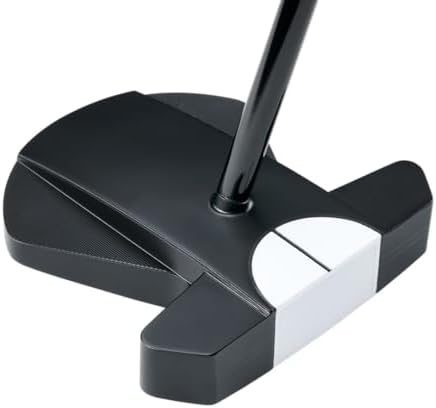
- Designed using artificial intelligence, this dual-layer insert has a soft urethane outer layer and a firm inner layer de…
- This new Forward Roll Design Groove is deeper and more aggressive. With a 19° slope it works in conjunction with the dua…
- A lightweight steel shaft with 20 grams of counterbalance weight in the butt end. Our testing consistently shows that pl…
2. L.A.B. Golf MEZZ.1 MAX: Best for Consistency
The MEZZ.1 MAX uses L.A.B.’s Lie Angle Balance technology in combination with an adjustable lie angle from 63° to 79.5° and an adjustable length from 28–38 inches. That adjustability is directly relevant for golfers over 40 who have modified their setup over the years to manage back, knee, or hip issues.
Today’s Golfer rated it silver in their 2025 panel test with a score of 80.57% across seven testers. It finished with no single weak category: consistent across stability, roll, and alignment: which is exactly what the consistency label means in practice. No catastrophic misses at any distance. No distance-specific weakness.
The Lucas Glover data point is worth examining. He switched to the MEZZ.1 MAX and won twice on PGA Tour in 2023 after years of putting struggles. Glover’s problem was anxiety-driven grip pressure spikes during his stroke. The MEZZ.1 MAX removed that variable mechanically. The experience maps directly to what putter grip style affects in the 40+ amateur game.
- Pros: Adjustable lie angle accommodates current posture, not ideal posture; consistent across all three distances; proven on PGA Tour under pressure conditions.
- Cons: Picking up the ball requires adapting your routine: the design does not allow the standard ball retrieval motion; custom versions can exceed $500.
3. Sub 70 011-SQ: Best Budget Option
At $229, the Sub 70 011-SQ finished as MyGolfSpy’s runner-up in a 26-model field in 2026. Runner-up in a 26-putter blind performance test at $120 less than the winner is not a minor result. Sub 70 is a direct-to-consumer brand that has consistently outperformed its price point in multiple equipment categories.
The 011-SQ’s square body design follows the same mechanical principles as the major-brand zero-torque putters: the shaft axis runs directly above the center of gravity, producing the same face-neutral stroke as the Odyssey at $349. For a golfer over 40 who wants to test whether zero-torque design suits their stroke before committing to premium pricing, this is the logical starting point.
The trade-off is adjustability. The 011-SQ comes in fixed lengths and lie angles, which means it works well if your setup is standard. Golfers over 40 who have significantly changed their posture may find the L.A.B. adjustable models worth the price premium. But for golfers in a standard setup range, the 011-SQ tests close enough to the Odyssey that the $120 difference is hard to justify on performance alone. The right putter grip size will matter as much as putter choice at this level.
- Pros: $229 lowest price for genuine zero-torque performance; MyGolfSpy 2026 runner-up across 26 models; no retail markup via direct-to-consumer model.
- Cons: Fixed length and lie with no adjustment for modified posture; fewer fitting options than L.A.B. models.
4. Wilson Infinite Zero Torque Lakeview: Best for Short Putts
MyGolfSpy’s 2026 PuttView data gives the Wilson Infinite ZT Lakeview a specific designation: best-performing zero-torque putter from 5 feet. For golfers over 40 who are losing shots on the 5-to-8-foot range: the exact distance where putting anxiety concentrates: this is a targeted solution at $199.99.
Wilson’s Infinite putter line has been consistent in amateur testing for distance control. The zero-torque variant applies a face-neutral design to a head that was already respected for pace management on short putts. The combination produces the short-range specialist result MyGolfSpy confirmed in their 2026 data.
The limitation is real: from 20 feet, the Odyssey S2S #7 and L.A.B. MEZZ.1 MAX outperform it. If you are primarily losing strokes on lag putts and 3-putts, the Lakeview is not your best option. If your scorecard shows the damage at 5–8 feet, it is the most affordable targeted fix in this list.
- Pros: Best short-putt performance in 2026 testing; $199.99 most affordable in our lineup; zero-torque design benefits golfers over 40 experiencing anxiety on short putts.
- Cons: Long putt performance is average versus the field; fewer customization options.

- Wilson Infinite Zero Torque Lakeview- Right Hand, 35″
- DOUBLE-MILLED FACE: Our double-milled face pattern ensures a consistent feel, roll and perfect distance control no matte…
- PVD ANTI-GLARE FINISH: Two tone PVD anti-glare finish reduces distraction, allowing the player to focus solely on the ba…
5. L.A.B. Golf DF 2.1: Best for Arthritic Hands and the Yips
The DF 2.1 (DF stands for Dead Face) is CNC-milled from 6061 aircraft aluminum, a lightweight alloy that reduces the grip force needed to control the putter through impact. This matters directly for golfers over 40 managing arthritis or reduced hand strength. Less grip pressure required means less grip inconsistency feeding into the stroke.
The adjustable lie angle (63° to 79.5°) and length (28–38 inches) go further than any other model in this list. Golfers over 40 who have changed their posture to manage back, knee, or hip issues over the years can dial this putter into their current stance rather than their ideal one. That is a practical advantage no fixed-geometry putter provides.
Richard Bland won on the European Tour after switching to L.A.B.’s MEZZ.1 technology (the same Lie Angle Balance system the DF 2.1 uses). His feedback emphasized one thing: the mechanical stability let him stop actively managing the face through impact. For golfers over 40 experiencing the yips, that single change: trusting the putter to stay square: reduces the number of conscious decisions during the stroke. Fewer decisions under pressure means fewer involuntary muscle responses. It is the psychological mechanism the technology actually fixes.
- Pros: Most forgiving of grip pressure inconsistency in our lineup; aluminum construction reduces required grip force; broadest adjustability range for modified postures.
- Cons: Unconventional head shape has a significant adjustment period; alignment markings are minimal compared to Odyssey; fully custom versions are expensive.
How to Match a Zero-Torque Putter to Your Stroke
Not every zero-torque putter works equally for every putting stroke. The technology is most compatible with specific stroke patterns. Getting this wrong reduces the face-stability advantage before you even leave the pro shop.
For a straight-back-straight-through stroke (the most common pattern for golfers over 40 who have reduced rotational mobility), any putter in this list performs well. The face-neutral design matches a stroke that already wants to stay square throughout the arc. This is also the stroke pattern most aided by proper grip setup at address, which applies equally here.
For a gentle arc stroke (still natural for golfers who learned the game from classic instruction), zero-torque works only if you keep your hands passive through impact. The MEZZ.1 MAX’s adjustable lie angle helps by allowing you to tune the setup to encourage natural hand position rather than fighting your stroke shape.
For a high-arc stroke: zero-torque technology will actively fight your natural stroke path. This is the one case where a traditional face-balanced mallet remains the better choice. If your arc is pronounced and grooved, switching to zero-torque requires rebuilding your stroke: not worth it for most golfers over 40 who have a reliable pattern.
The simplest diagnostic: on a 10-foot practice putt, roll the ball without thinking about your stroke. Where does the putter face want to go through impact? If it stays square naturally, zero-torque is a match. If the face opens during your natural swing, spend 20 minutes with a demo before buying.
Does a Zero-Torque Putter Help the Yips?
The yips are partly mechanical and partly psychological. Zero-torque putters address both, but differently.
The mechanical problem: golfers experiencing putting anxiety grip the putter harder as anxiety increases: often unconsciously. Standard mallets amplify this because uneven grip pressure transfers directly into face rotation at impact. Zero-torque design decouples grip pressure from face rotation. The face stays square even when the grip tightens involuntarily through the stroke.
The psychological mechanism: knowing the face is mechanically neutral removes one active decision from the putting stroke. Golfers over 40 experiencing putting anxiety do not need to consciously hold the face square. The putter does it. Fewer conscious decisions during the stroke means fewer triggers for the involuntary muscle contraction that defines the yips response.
Today’s Golfer’s 2025 72-putter test provides supporting data: the zero-torque category leader, the Odyssey Ai-One Square 2 Square Jailbird,: scored highest for stability in the entire 72-putter test. High stability specifically reduces the face-rotation amplitude of a yips tremor. The face still moves slightly during a yips episode, but the zero-torque geometry limits how far it opens or closes before returning to neutral. That reduced amplitude is what makes more putts findable for golfers over 40 living with the condition. If you want to pair this work with specific drills, putting training aids tested for the 40+ game can reinforce the mechanical benefit.
The honest caveat: zero-torque does not cure the yips. It removes one of the physical inputs that makes putting anxiety worse. For most golfers over 40 who experience yips symptoms, the outcome is reduced severity rather than elimination: but reduced severity on a 6-footer with the match on the line is a meaningful improvement.
Frequently Asked Questions
What is a zero-torque putter?
A zero-torque putter aligns the shaft axis directly above the putter head’s center of gravity, removing the face’s natural tendency to rotate during the stroke. The face stays square to the target line without any active grip manipulation to hold it there.
Are zero-torque putters legal under USGA rules?
Yes. USGA putter design rules do not prohibit zero-torque construction. The shaft-to-CG alignment used by L.A.B. Golf, Odyssey Square 2 Square, and similar models is fully conforming under the Rules of Golf.
Do zero-torque putters help with the yips?
They can reduce severity. Zero-torque design removes face rotation as a variable by decoupling grip pressure from face movement. Golfers over 40 experiencing putting anxiety often find that the mechanical consistency of a zero-torque face helps interrupt the anxiety-grip-miss cycle that feeds yips symptoms.
What is the best zero-torque putter for someone on a budget?
The Sub 70 011-SQ at $229. It finished as MyGolfSpy runner-up across a 26-model 2026 blind performance test. The performance gap between it and the $350 winner is smaller than the price gap suggests. It is the most direct entry point into genuine zero-torque performance.
Does a zero-torque putter work for golfers with slower putting tempos?
Yes. Zero-torque performance is not affected by putting tempo or full-swing speed. The benefit is mechanical: face rotation is eliminated regardless of how fast or slow the stroke moves through impact. Golfers over 40 across a wide range of tempos report consistent results from zero-torque design.
Is the L.A.B. Golf MEZZ.1 MAX worth the price for an amateur golfer?
For golfers who have changed multiple putters without fixing stroke inconsistency, yes. The adjustable lie angle and length allow it to match your current posture: not the setup you had years ago. The downside is that picking up the ball requires a modified routine, and custom versions can exceed $500. Start with the stock version if you are testing the technology for the first time.
